
Innovation Unscripted™ is not a style.
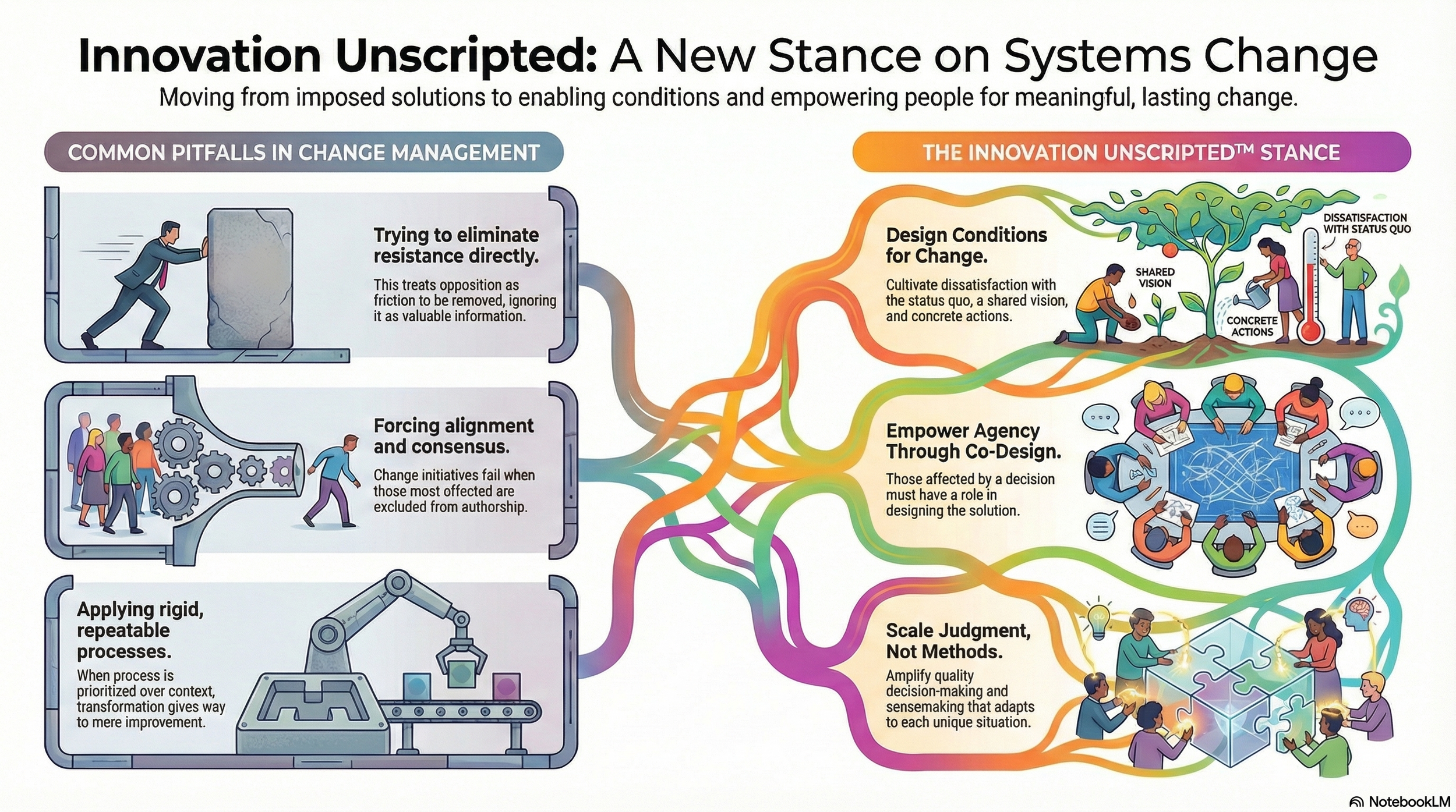
It is a stance on power, agency, and responsibility in systems change. We work on and in complex systems where progress is contested, power is uneven, and resistance is ingrained. Through decades of practice across governments, institutions, and frontline services, we have arrived at a clear stance on how meaningful change actually happens—and why so much of it fails.
1. Systems shift through designing conditions, not eliminating resistance
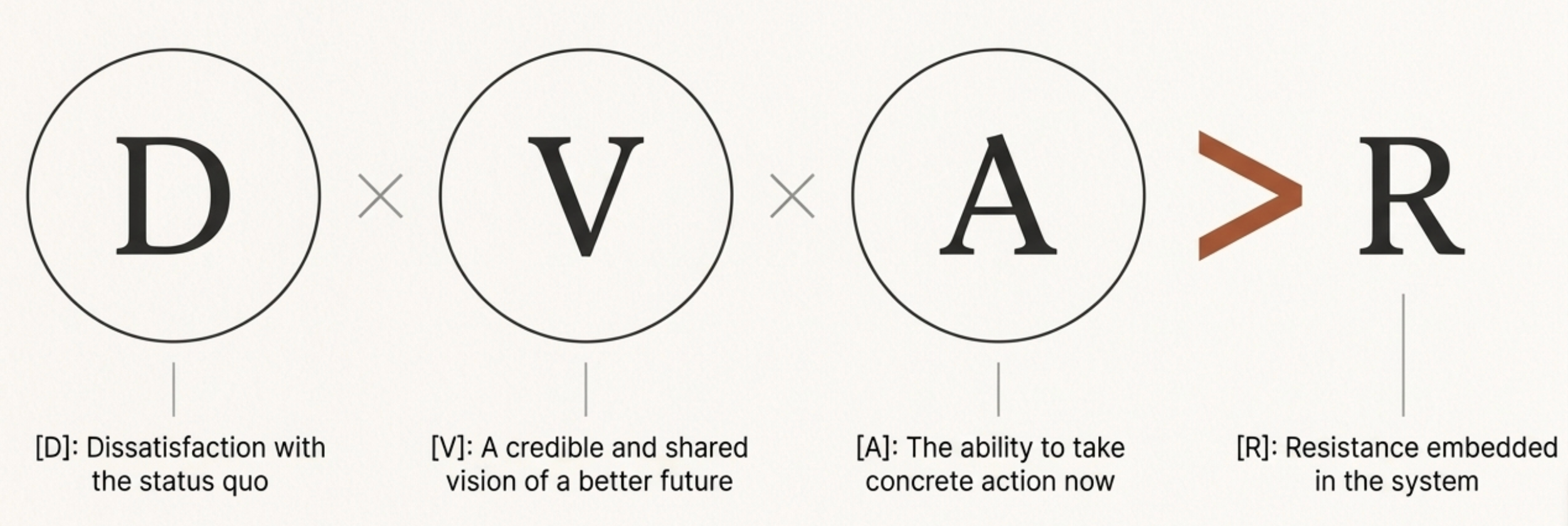
The conditions for systems change are summarized by the formula for change: Lasting change occurs only when dissatisfaction with the status quo (D), a credible and shared vision of a better future (V), and the ability to take concrete action now (A) together outweigh the resistance embedded in the system (R). If any one of these conditions is weak—if people do not feel the need for change, cannot see themselves in what comes next, or lack real ways to act—resistance will dominate and change will stall. The leadership task is not to eliminate resistance directly, but to design the conditions of the system so that dissatisfaction, vision, and action reinforce one another, making change the rational and legitimate path forward.
2. Agency matters more than alignment
Change initiatives do not fail because people resist change. They fail because people who bear the costs and risks of change are excluded from authorship. Change that is managed rather than co-created accumulates resistance until it collapses.
3. Co-design substance, not just optics
If a decision materially affects someone’s work or lived reality, they or a legitimate representative belong in the design of the solution itself, not just the superficial features or the communication plan.
4. Context outweighs process
Complex problems are irreducibly unique. When methods harden into repeatable sequences, attention shifts from the situation to the process. The result is at best improvement, not transformation.
5. Judgment scales better than methods
What can be standardized is not solutions, but the quality of sensemaking, ethics, and decision-making under uncertainty. We amplify judgment rather than replicate methods.
6. Opposition is information, not obstruction
Resistance signals risk, identity, exclusion, fatigue, or legitimate concern. Treating opposition as friction to be removed converts insight into sabotage.
7. Evidence establishes possibility, not certainty
We act when there is credible evidence that a path could work based on precedent, local practices, and prototyping. Waiting for certainty is neither realistic nor responsible.
8. Legitimacy sets the speed limit
There are moments when momentum is essential because change windows close quickly. But speed without trust forecloses durability. We move fast once legitimacy exists—and slow down when it does not.
9. Portfolios outperform consensus
Loosely coupled portfolio interventions allow systems to learn, adapt, and progress without forcing premature agreement or uniformity. Consensus is unnecessary, and often undesirable, for complex change.
10. Build capacity, not dependency
Our role is to leave institutions and participants stronger, more confident, and more capable of navigating future complexity without requiring our continued presence.
11. Means and ends are inseparable
We never pursue leverage through intentional harm, disinformation, polarization, othering, or manipulating peoples’ choices. Outcomes achieved through illegitimate means are themselves illegitimate.
12. Progress is a preferable set of problems, not a perfect ending
Complex problems never have clear, final solutions. A system is moving in the right direction when the future set of problems is preferable to the old set of problems for more stakeholders, especially historically underserved communities.